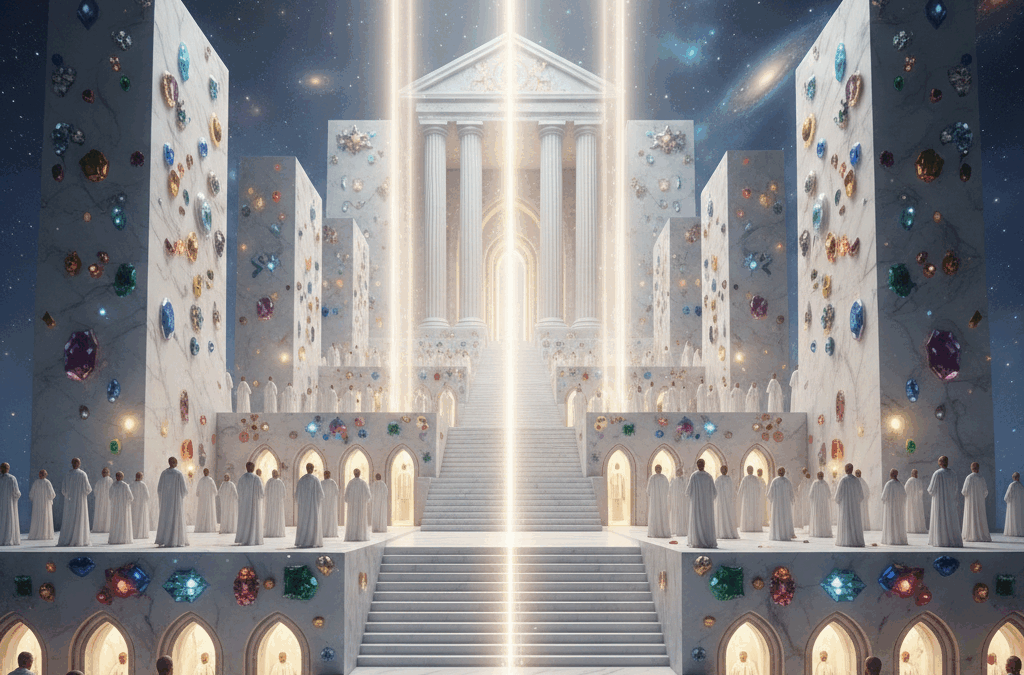
It’s hard to tell from looking at it whether the bridge of prayer God has built is a bridge or a massive cathedral complex. Its massive portico on the Earth’s side of the divide could easily accommodate a thousand people shoulder to shoulder. The transition is unmistakable as you step onto three marble stairs so polished and clean it is hard to tell whether they reflect the light around them or are their own source of light.
With each step up, the view of the wall in front of you becomes clearer. The sheer mass and immensity of the wall dwarf you as it seems to climb into the clouds. At the same time, the beauty and majesty of this work of art exalt and fill you with childlike awe. Dazzling seems so trivial a word to describe the white of the stone. But with each step up, you realize it’s not just plain white. And then you see it. The whole wall appears to be a single piece of white marble terrazzo endlessly flecked with every shade of precious stone—diamonds, opal, topaz, ruby, sapphire, amethyst, emerald, aquamarine, and citrine, to name a few—each causing beams of light to dance to their own tune. The light becomes a ballet of wonder with each step, each tilt of the head, each dart of the eye. The base of the wall is filled with thousands of gates, all thrown open wide. Each gate and the space between them are ornately decorated with depictions of mighty and glorious acts of the King. And above every gate, as though carved from a single piece of gold, are the words that the heralds standing at each entrance shout with seemingly endless enthusiasm:
Prepare To Meet The King.
Through the gate is another stairway, this one of twelve steps. A landing follows each step. And on every landing stand hundreds of the King’s ministers dressed in the whitest linen. They are in themselves beautiful, powerful, benevolent, and yet dangerous. They hold their own dignity and nobility, and they shine with the glory of those who have lingered long enough in the King’s presence to reflect His unmistakable glow. Each stands on these stairs to offer whatever assistance they can to those journeying toward an audience with the King: a word of encouragement, a fresh set of clean clothes, an offer of refreshment, a balm for a wound, a shoulder for a burden, faith for the faltering. Some sojourners linger long on the ascent of preparation, receiving gifts and often listening and joining in with the songs of praise that spontaneously burst from various servants. Others pass through as quickly as they can, foregoing the offered gifts in their haste to see the King. The ministers the hurried rush past accept their choice without judgment or condemnation, but with a hint of sadness.
As you reach the final landing—the last of the twelve—the air itself seems to shift. It carries a weight, not oppressive but substantial, the way a warm blanket carries the weight of comfort. It is the scent of holiness, of nearness, of invitation.
Here, at the top of the stairs, the path opens into a vast colonnade. Pillars rise like living trees, carved with stories older than memory: creation sung into existence, seas split by breath, stones yielding water, prodigals embraced, sinners forgiven, lambs lifted onto shoulders, graves emptied by love stronger than death.
Each pillar is a sermon, a history, a promise—silently proclaiming that the King you are approaching is not distant, not indifferent, not unpredictable.
He is the One who sees.
The One who comes.
The One who stays.
Across the colonnade stands the Palace—magnificent beyond description. What makes this Palace so unique is not one door of entrance, but thousands. Each has been lavishly decorated as though thousands upon thousands of masters of their craft had spent lifetimes adding one perfect touch until they were complete. Each of the thousands of doors names and depicts one attribute of the King. Each is a glimpse of a piece of His majesty. Each is a witness to His goodness. Each door pulses and bursts with the light of His glory. A vast choir of heaven’s dwellers moves endlessly back and forth before the doors, reciting each name and singing praises to the King they describe. Those who join and leave this choir periodically feel the weight of the privilege they have been given. It is a burden they carry with reverent joy.
There are words to describe the reality of this place, but humans left them in Eden. There is a promise that the King will grant them to sing and know their meaning again one day.
It’s easy to forget, amidst all the grandeur, that the journey so far has been nothing more than preparation to enter the presence of the King. And now the time has come. The door is before you. The touch of the knob stills your breath, and from the bottom of your soul involuntarily rise your deepest longings and your deepest fears. This place vibrates with grace and truth, justice and mercy, and an immensity of otherness. Sacred and Holy aren’t concepts here; they are the deep, thunderous drums whose reverberations stitch together the very fabric of reality. Here, on the threshold of His direct presence, the lies you tell yourself elsewhere tremble, knowing eradication awaits them in the light of His glory.
As you enter the throne room, you are momentarily disoriented by an avalanche of presence and glory. His unsearchable goodness awakens an insatiable thirst to fulfill your destiny and to drink deeply of His love. Yes—you were made for this. His welcoming benevolence triggers the instinct to run with reckless abandon and throw yourself into His lap. And yet His power, His majesty, His justice, and the sheer otherness of His being drive you to your knees, forehead to the floor, the shock and awe of His presence too wonderful and too fearful for you. Reflexively, you cry out with all your being:
Holy, Holy, Holy are You, my Creator, Redeemer, and God.
Hallowed be Your name.
After a moment—or an eternity—of abandoned worship, the Prince of Peace comes, gently lays a hand on your shoulder, and bids you rise. As you unfold yourself, you can hear the darkness you carry in your heart cowering in fear, begging you to protect it, reminding you that it has always been part of you. This is the age-old struggle: the battle between the already and the not-yet, lived out in your own heart. But the battle is interrupted, because Majesty is moving. You lift your eyes and, in the face of the One who breathed life into you, see a gentle smile and knowing eyes gleaming with delight. Only then does it dawn on you afresh:
The King is your Dad.
(to be continued)